
Colton Epoxy Flooring resurfaces pool decks throughout Colton, CA, and the surrounding cities including Grand Terrace, Loma Linda, Highgrove, Bloomington and Rialto, with more than twenty years of exterior concrete work in this valley. A pool deck is the most demanding residential slab we work on, and almost nothing about it is like a garage floor.
Three things make it different. It lives in full sun, so ultraviolet stability and surface temperature both matter. It is regularly wet, so slip resistance is a specification rather than a preference. And people walk on it barefoot, which turns heat and texture into comfort questions instead of technical ones.
Get those three right and a resurfaced deck outlasts the one it replaced. Get any of them wrong and the failure is obvious every day of summer.
Why an Exterior Slab Is Its Own Problem
Ultraviolet Exposure
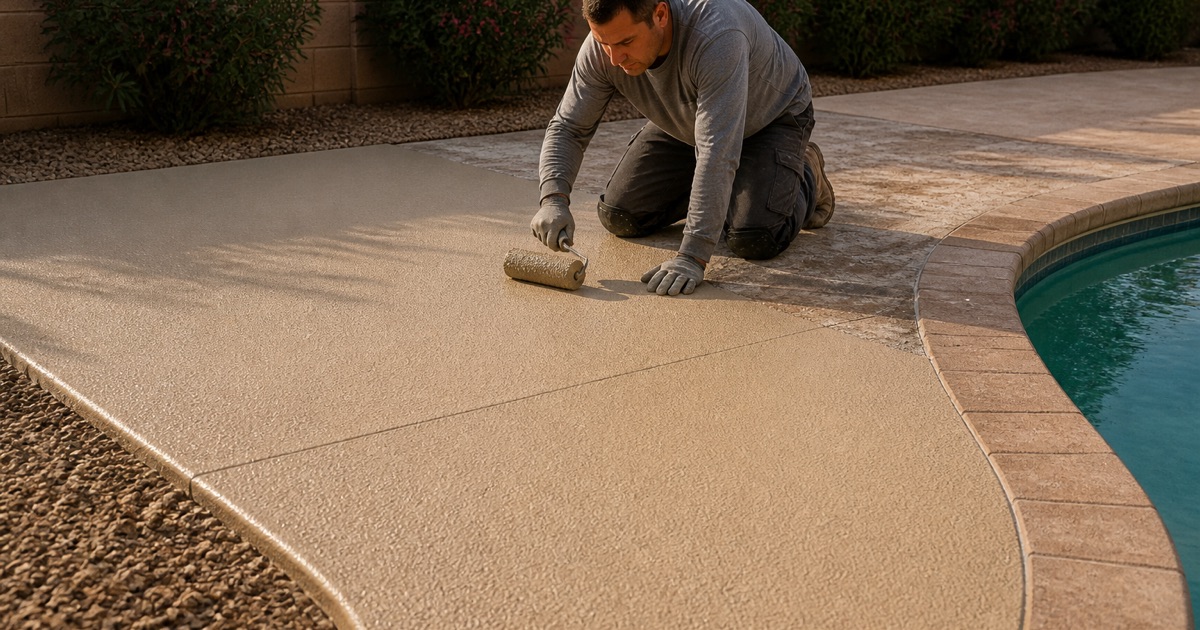
Epoxy ambers under ultraviolet light — a property of the chemistry rather than a defect — so a straight epoxy topcoat outdoors yellows within a season or two. Exterior work gets aliphatic chemistry instead, polyaspartic or polyurea, which holds its color in direct sun. That single property is why the system on a deck differs from the one in the garage a few feet away.
Surface Temperature and Bare Feet
A dark exterior slab in inland sun gets hot enough that nobody will cross it barefoot, which makes color a comfort decision rather than a design one. Infrared-reflective pigment reduces how much heat a given color absorbs, widening the palette that is actually usable around a pool. No exterior slab here is cool in August, but the gap between a considered color and a dark one is easily the gap between usable and not.
Thermal Movement
An exterior slab expands and contracts far more than an interior one, cycling every day between night and afternoon. That movement has to be accommodated at joints and at the perimeter rather than bridged, because a rigid finish carried across a moving joint cracks along it within a season. Every existing joint is carried through the new surface rather than covered over and hoped about.
Systems We Install on a Deck
Polymer-Modified Cementitious Overlays
The most common answer on a worn or scaled deck is a polymer-modified overlay, applied in thin lifts over prepared concrete. It restores a uniform surface, takes integral color, and can be textured or stamped while it is still plastic. It also breathes better than a sealed resin film, which matters on a slab that stays damp from splash-out and irrigation for much of the year.
Textured and Stamped Finishes
An overlay does not have to look like a repair. Stamped patterns, broomed and knockdown textures and integral color with release agents all give a deck real character while building slip resistance into the surface rather than adding it afterwards. Texture that is part of the finish cannot wear off separately from it, which a broadcast grit applied at the end can.
Polyaspartic and Polyurea Coatings
Where a resinous finish is wanted, exterior systems use aliphatic polyaspartic or polyurea with aggregate broadcast in for grip. These cure quickly, hold color and tolerate a wide temperature range, though they need a sound slab underneath and are less forgiving of moisture than a cementitious overlay. That is why we test the slab before choosing between the two rather than after.
Slip Resistance, Specified Properly
Texture Designed In, Not Added On
Any deck that gets wet needs texture built into the finish rather than sprinkled on at the end. Broadcast aggregate, a knockdown texture or a stamped profile all provide it, and each gives a different feel underfoot. We choose the level against slope and use rather than applying one answer everywhere, because a flat surround and a sloped approach are genuinely different problems.
Quotable Rather Than Described
Where slip resistance genuinely matters we would rather quote a DCOF figure against a specified finish than describe a surface in adjectives. A pool surround and a covered walkway are different problems, and specifying the same texture for both means one of them is wrong. A number in the scope is something you can hold us to; an adjective is not.
Comfort Against Grip
The trade-off worth naming is that more aggressive texture grips better and feels harsher on bare feet and on knees. We aim at the level that is genuinely safe wet without being unpleasant dry, and it is worth walking a sample before committing. Ten seconds barefoot on a sample board settles an argument that no description resolves.
Preparation and Drainage
Assessing the Slab First
We check whether the problem is the surface or the slab. Scaling, spalling and general wear resurface well; widespread structural cracking or settlement is a replacement problem, and an overlay over either fails visibly within a season. We would rather lose the job than take it on a slab that needs replacing.
Correcting Fall and Ponding
Resurfacing is the moment to fix minor drainage problems, and the moment to make them permanent if it is done carelessly, because an overlay follows the slab beneath unless correction is deliberately designed in. Where ponding is the actual complaint, that is a decision to make at quoting rather than something to notice after the first rain of the season.
Bond Comes From Profile
The existing deck is ground or shot blasted to the concrete surface profile the system requires and everything that would interfere is removed — old sealers, coatings, curing compounds and contamination. Pressure washing removes what is loose and leaves exactly the bonded layer that has to go, which is why a quote naming it as the preparation is quoting a shorter-lived job.
- 20+ Years Experience
- Free Estimates
- Every Slab Moisture Tested