
Colton Epoxy Flooring installs metallic epoxy floors throughout Colton, CA, and the surrounding cities including Grand Terrace, Loma Linda, Rialto, Highgrove and San Bernardino, with more than twenty years of resinous flooring behind us. A metallic floor is the most decorative system we install and the one that needs the most honest conversation before it starts.
The reason is simple: a metallic pour is directed rather than controlled. Pigment is dispersed through a clear resin and then moved, and the marbling that results is a product of that movement. It cannot be repeated exactly, matched to a photograph, or promised in advance.
Handled properly that is the appeal rather than a drawback. Every metallic floor is genuinely unique, and the depth in a good one is something no printed or tiled surface reproduces.
How a Metallic Floor Is Actually Made
Pigment Suspended in Clear Resin
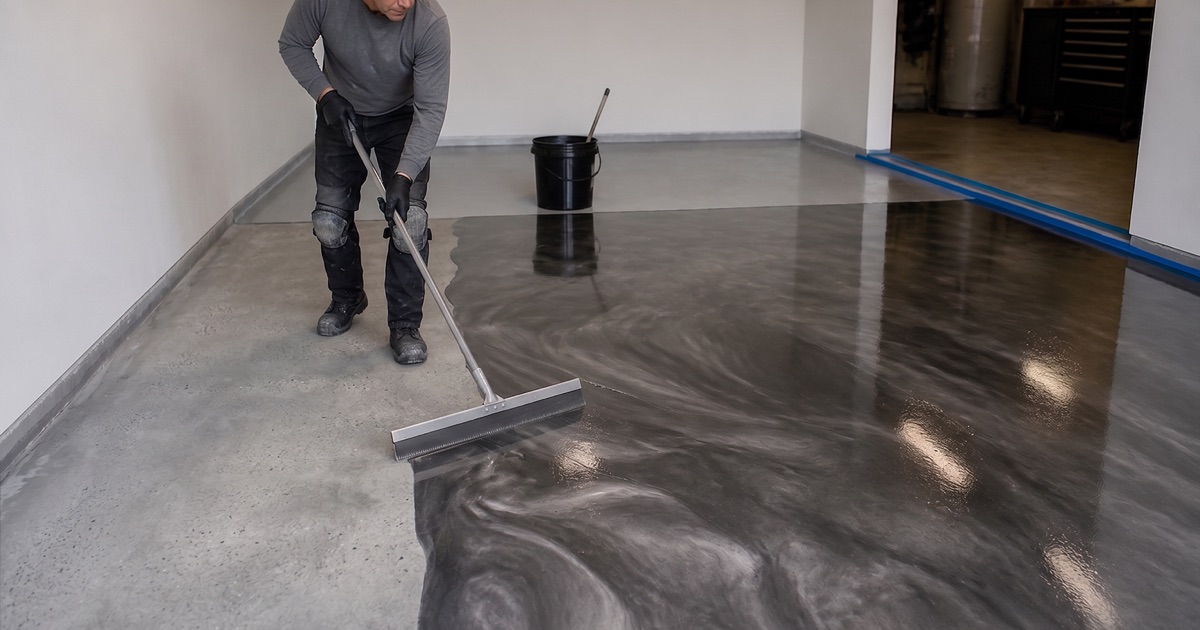
Metallic pigments are reflective particles suspended in a clear or lightly tinted 100% solids epoxy. Because the resin is transparent, light passes into the film, reflects off pigment at different depths and comes back out, which is what produces the sense of depth rather than a flat printed appearance. Nothing printed, tiled or stained reproduces that effect, because the depth is real rather than represented.
Moving the Resin to Create the Marble
Once the resin is down it is worked — rolled, spread, brushed, blown with air, sometimes combed — and the pigment separates and pools along those movements. Different techniques give different characters: broad slow movement gives large, calm veining, while air pressure gives sharp cells and tight structure. We agree which of those characters you are after before the pour, since it is the one decision that cannot be revisited afterwards.
Why No Two Pours Match
The final pattern depends on how the resin flowed, how the pigment settled, the ambient temperature, the film thickness and the exact hand movements of whoever laid it. That is genuinely uncontrollable at the fine scale, which is why we show worked examples of character rather than promising a specific pattern. Anyone guaranteeing you an exact match to a photograph is describing something the process cannot deliver.
Where a Metallic Floor Works
Garages and Home Interiors
Metallic floors are popular in enthusiast garages, home gyms, basements elsewhere and interior living areas where the floor is meant to be looked at. In a working garage they show tire marks and scuffing more than a flake floor does, which is a trade-off worth making deliberately rather than discovering later. Where the garage genuinely stores things and holds working vehicles, we will usually point you at flake instead.
Showrooms, Retail and Reception Areas
Commercially, metallic belongs where the floor is part of the presentation — showrooms, retail, reception areas, salons, restaurants and studios. It is a finish people photograph, which is its own argument in a business that markets itself visually. In those rooms the floor is doing marketing work rather than only covering concrete.
Where We Steer People Away From It
We do not recommend metallic in kitchens, wash-down areas, workshops or anywhere the floor takes heavy chemical exposure or genuinely hard use. Those rooms want a broadcast system with texture and chemical resistance, and putting a decorative floor into them is a disappointment on a schedule. Saying so costs us the job occasionally and it costs the customer far less than the alternative.
Getting the Substrate Right
Preparation Does Not Change
A metallic floor is only as durable as its bond, which means the same routine: moisture testing with the ASTM F1869 calcium chloride test and the ASTM F2170 in-situ relative humidity probe before ordering, mechanical grinding to the ICRI concrete surface profile the system requires, and repair of joints, spalls and contamination. A decorative floor over a poorly prepared slab fails exactly as a plain one would, and the loss is larger because the floor cost more.
Why Flatness Matters More Here
A clear, glossy, deep floor shows every undulation in the slab because reflections exaggerate them. On a floor where appearance is the entire point, we assess flatness before quoting and discuss leveling where the slab needs it, because a metallic finish highlights what a flake broadcast would have hidden. Where a slab needs leveling, that appears as its own line in the quote rather than as a surprise on the day.
The Base Coat Underneath
Metallic goes over a pigmented base coat, usually black or a deep tone, and that base does real work: it controls how much light reaches back through and sets the contrast of the finished floor. Choosing it is part of the design decision rather than a technical detail, and a lighter base under the same metallic produces a noticeably different floor.
Finish, Protection and Living With It
The Clear Topcoat
A metallic floor is finished with a clear topcoat, usually polyaspartic or polyurea, which provides the abrasion resistance and the ultraviolet stability the epoxy underneath lacks. Without it the decorative layer takes the wear directly and the floor ambers wherever daylight reaches it, which on a metallic finish is disfiguring rather than merely noticeable.
Gloss Level and What It Reveals
High gloss maximizes depth and shows dust, scratching and footprints most. A satin topcoat gives up a little of the effect and hides considerably more. In a room that is genuinely used every day, satin is usually the more livable choice and we will say so even when high gloss photographs better. The difference in depth is smaller in person than in a photograph, and the difference in maintenance is larger.
Repair and Refresh
The wear layer can be abraded and recoated without disturbing the decorative layer beneath it, which means a tired metallic floor can be refreshed rather than replaced. Damage that reaches through into the metallic layer itself is harder, because a repair cannot reproduce the surrounding pattern exactly. Small areas blend convincingly; a large one usually means recoating the whole floor to keep it consistent.
- 20+ Years Experience
- Free Estimates
- Every Slab Moisture Tested