
Colton Epoxy Flooring installs polyaspartic floor coating systems across Colton, CA, and the surrounding cities including Grand Terrace, Loma Linda, Bloomington, Rialto and San Bernardino, with more than twenty years of experience specifying resinous floors for this climate. Polyaspartic is the chemistry we reach for when a floor has to come back into service quickly or has to hold its color in sunlight.
It is worth being precise about what it is. Polyaspartic is a form of polyurea, an aliphatic one, and its two useful properties follow from that: it cures far faster than epoxy and it does not amber under ultraviolet light. Those two things are why it dominates topcoats and exterior work.
What it is not is a replacement for the whole system. On most floors polyaspartic sits over an epoxy body coat rather than instead of it, and understanding why is the difference between a specification and a sales pitch.
What Polyaspartic Actually Does
Fast Cure and Fast Return to Service
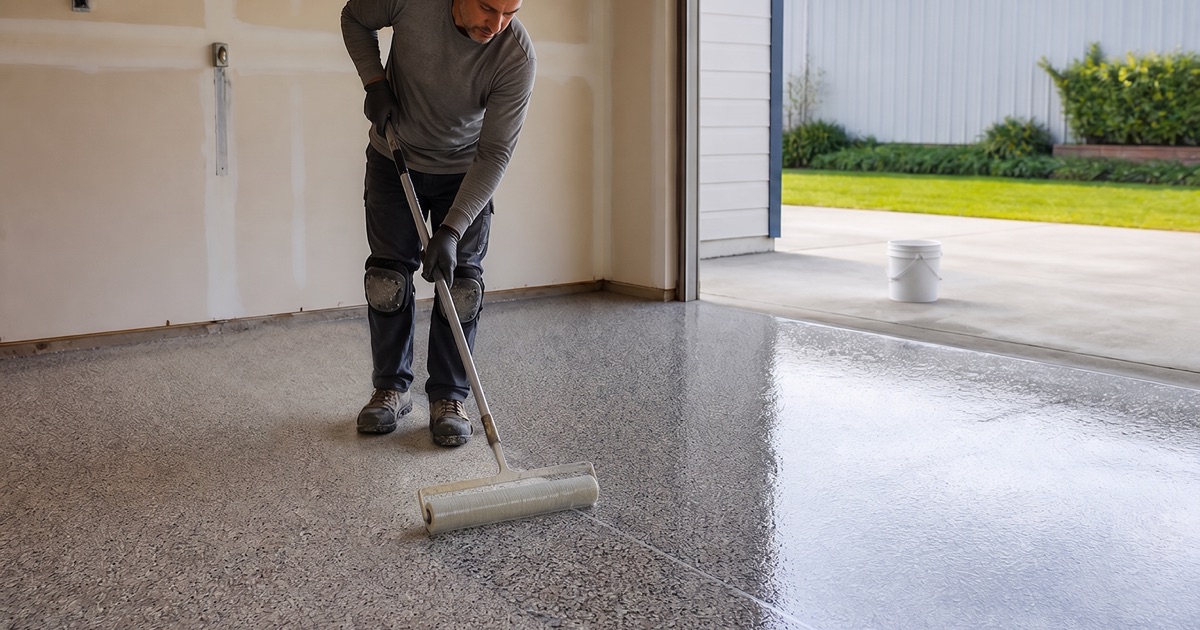
A polyaspartic topcoat can be walked on and returned to use dramatically sooner than an epoxy equivalent, which on a commercial floor is often the entire reason for choosing it. Where a business cannot be closed for several days, a fast-cure system converts a week-long shutdown into a weekend, and that saving is usually far larger than any difference in material price. For a restaurant or a clinic, three extra trading days recovered is worth more than the whole coating line on the invoice.
Color Stability Under Ultraviolet Light
Epoxy ambers in sunlight. It is a chemical property rather than a quality problem, and on a floor exposed to daylight through a door or a window it produces a yellowed cast within a year or two. Polyaspartic is aliphatic and stays color stable, which is why it goes on top of the epoxy rather than under it, and why exterior work uses it almost exclusively. The effect is most obvious on light gray and white floors, where a yellowing epoxy topcoat reads as dirt that will not clean off.
Temperature Tolerance in a Wide Window
Polyaspartic tolerates a wider application temperature range than epoxy at both ends, which matters in a valley where a garage slab can be cold in the morning and very hot by mid-afternoon. It widens the days on which work is possible, though it does not remove the need to read the actual slab temperature and dew point. We still take those readings on the morning of the pour, because a slab that has been in shade all night behaves differently from the air above it.
The Trade-Off Nobody Should Hide
A Short Pot Life
Speed cuts both ways. A fast-curing resin has a short working window, and on a hot Colton afternoon that window gets shorter still — on a common system, pot life running about 60 minutes at 55 degrees can collapse toward 20 minutes at 95 degrees. It is a material that punishes a crew working beyond its pace, which is why we batch small and plan the sequence across the slab in advance. It also means the crew size is set by the floor rather than by habit, since a large open area needs enough hands to keep a wet edge moving.
Thin Build Compared With Epoxy
Polyaspartic is generally applied at a lower film build than a 100% solids epoxy body coat, so it is not the layer that gives a floor its thickness. Asking it to be both the build and the wear surface produces a thinner floor than the customer thinks they bought, which is one reason we specify the layers by name in writing. If a quote says only polyaspartic and gives no film build, it is worth asking what is actually carrying the thickness.
Why Most Systems Use Both
The practical answer on most floors is a hybrid: an epoxy primer and body coat to build the film and grip the concrete, the flake or quartz broadcast into that, then a polyaspartic or polyurea clear coat over the top for speed, ultraviolet stability and abrasion resistance. Each layer does the thing it is actually good at. That hybrid is what we install on the large majority of garages and commercial floors here, and it is what our written scope describes layer by layer.
Where We Specify It in Colton
Garage Floors That Need to Be Back in Use
On a residential garage the polyaspartic topcoat is what shortens the wait to park on the floor, and what stops the finish yellowing where the door is open half the day. For a household with one garage and nowhere else to put a car, that shortened return to service is frequently the deciding factor. It also reduces the window during which a half-finished floor is exposed to dust, which on a residential job usually means the difference between one disruption and several.
Commercial Floors in Buildings That Cannot Close
Kitchens, clinics, retail floors and tenant spaces rarely have a week to give up. A fast-cure system worked in phases overnight or across a weekend is often the only way the job happens at all, and the sequencing plan matters as much as the product choice. In practice we walk the space with whoever runs it and agree the order of rooms before quoting, because that order determines how many nights the job takes.
Patios, Pool Decks and Driveways
Outdoors, ultraviolet stability stops being a preference and becomes a requirement, so exterior slabs get polyaspartic or polyurea rather than an epoxy topcoat. Texture is broadcast in for slip resistance, and color is chosen with surface temperature in mind, because a dark exterior floor in inland sun gets hot enough to matter underfoot. Infrared-reflective pigment reduces how much heat a given color absorbs, which widens the palette that is genuinely usable around a pool.
How We Install It
Preparation Does Not Change
Fast chemistry does not reduce the preparation. The slab is still moisture tested before product is ordered, still ground mechanically to the ICRI concrete surface profile the system requires, and still repaired at joints, spalls and oil-contaminated areas. A polyaspartic floor over unprepared concrete fails exactly as an epoxy one would, only sooner in the day. Fast chemistry shortens the time between a preparation shortcut and the moment it becomes visible, which is the opposite of forgiving.
Batching and Sequencing to the Pot Life
We mix to the working window rather than to convenience, splitting the floor into sections that can be laid, broadcast and back-rolled inside the pot life at the temperature on the day. On hot days that means earlier starts and smaller batches, and it is the single biggest determinant of whether the finished surface is uniform. Where a floor is too large to hold a wet edge in one pass, we plan a deliberate break at a joint or a doorway rather than letting one appear at random.
Recoat Windows and Getting Them Right
Fast-cure systems have recoat windows that close as quickly as they open. Miss one and the next coat has to be abraded in mechanically rather than bonding chemically to the coat below, which costs time and can show. We plan the day around those windows rather than around the clock. That is also why a polyaspartic job rarely stops halfway through a coat, and why we would rather move a start date than begin one we cannot finish.
- 20+ Years Experience
- Free Estimates
- Every Slab Moisture Tested