
Colton Epoxy Flooring provides concrete resurfacing throughout Colton, CA, and the surrounding cities including Grand Terrace, Bloomington, Highgrove, Rialto and Fontana, with more than twenty years spent repairing and refinishing concrete across the San Bernardino Valley. Resurfacing is what we recommend when a slab is structurally sound but its surface has stopped doing its job.
That describes a great deal of concrete in this city. Colton is old — nearly three in ten homes predate 1960 — and decades of sun, traffic and weather wear a surface out long before the slab beneath it gives up. Replacing that concrete is expensive, disruptive and frequently unnecessary.
The judgment call is whether the slab underneath is worth building on. We assess that first, plainly, because resurfacing a slab that needed replacing wastes your money and ours.
When Resurfacing Is the Right Call
Surface Wear Rather Than Structural Failure
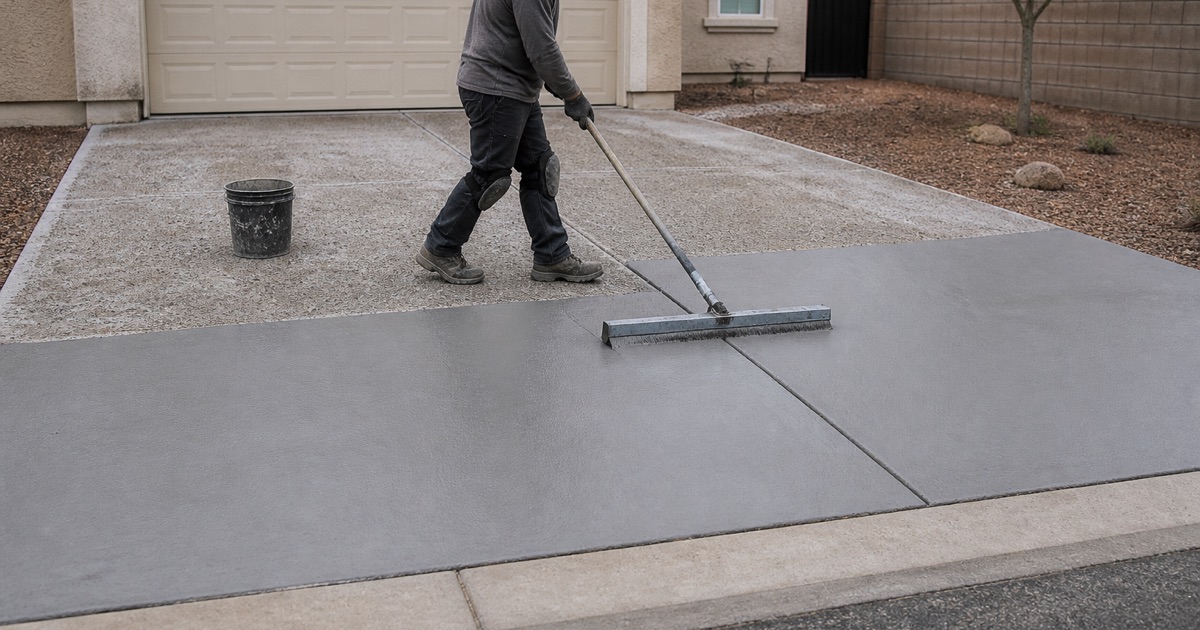
Scaling, spalling, crazing, exposed aggregate from erosion and a general chalky, worn appearance are surface conditions. If the slab holds its shape, carries its load and has no serious structural cracking, those are exactly the problems an overlay is designed to fix, and the fix costs a fraction of removal and replacement. It is also far less disruptive: there is no demolition, no haulage and no waiting on a fresh pour to reach strength before anything can go on it.
Cracks That Move and Cracks That Do Not
Not every crack rules resurfacing out, but the distinction matters. A dormant shrinkage crack can be repaired and covered. An active crack, one still moving with load or settlement, will telegraph through any overlay put over it, so it has to be addressed structurally or honored as a joint in the new surface rather than hidden. We work out which kind you have by looking at the crack edges and the pattern across the slab, and where it is genuinely uncertain we say so rather than guess.
When We Will Tell You to Replace Instead
Widespread structural cracking, significant settlement, a slab that rocks under load, or concrete that has deteriorated through its depth are all replacement problems. Putting an overlay over any of those buys a season and then fails visibly. We would rather lose the job than sell that. It is also worth knowing that a slab can be sound in one area and finished in another, so partial replacement combined with resurfacing is sometimes the sensible middle answer.
Resurfacing Systems We Install
Polymer-Modified Cementitious Overlays
The workhorse of exterior resurfacing is a polymer-modified cementitious overlay, applied in thin lifts over a prepared slab. The polymer gives it the bond strength and flexibility that plain cement mortar lacks, so it can go down thin without debonding. It is what turns a scaled driveway or a pitted patio back into a uniform surface. Applied correctly it bonds as part of the slab rather than sitting on it, and it can carry color and texture at the same time.
Microtoppings and Skim Coats
Where the surface is worn but reasonably intact, a microtopping or skim coat only a fraction of an inch thick can restore a smooth, uniform finish. These are the right choice on interior floors and covered patios, and they accept color and finish work well while adding almost no height at thresholds. That last point matters more than people expect indoors, because a doorway that no longer clears is an expensive thing to discover after the fact.
Stamped and Textured Overlays
An overlay does not have to look like a repair. Stamped and textured systems can be worked while wet to produce patterns, and integral color plus release agents give the finished slab depth. This is the route people take when the goal is to change how a patio or pool surround looks as well as to fix it. Stamping is done in a working window while the material is still plastic, so the layout and the pattern have to be agreed before anything is mixed.
Resinous Systems Over Interior Slabs
Indoors, a resurfacing job frequently ends in a resinous system rather than a cementitious one. A worn interior slab can be ground flat, repaired and then given an epoxy or polyaspartic floor, which is often the better answer where chemical resistance or cleanability matters more than appearance alone. Workshops, utility rooms and garages usually fall into that category, and the preparation for it is the same grinding and repair sequence either way.
Preparation Decides Whether It Bonds
Mechanical Profile First
An overlay is only as good as its bond, and bond comes from mechanical profile. We grind or shot blast the existing slab to the concrete surface profile the system requires and remove everything that would interfere — old sealers, coatings, curing compounds, laitance and contamination. Nothing is applied over a surface that has only been washed. Pressure washing removes what is loose and leaves everything that is bonded, which is precisely the layer an overlay needs gone.
Repairing Before Resurfacing
Spalls are cut back to sound concrete and patched with a compatible repair mortar, cracks are treated according to whether they move, and joints are identified so they can be carried through the new surface. Concrete contaminated with oil is treated before anything cementitious goes over it, because oil defeats a bond just as thoroughly as dust. On a driveway the contaminated area is usually obvious and localized, and treating it properly is quicker than dealing with the debonded patch it would otherwise become.
Honoring the Joints
The single most common way an overlay fails cosmetically is joints being covered rather than continued. Control and expansion joints exist because the slab needs somewhere to move, and an overlay bridging them cracks along the line underneath within a season. We carry every joint through the new surface. Where a slab has no joints at all and is large enough to need them, we discuss cutting them in as part of the work rather than hoping the overlay copes.
Exterior Slabs Need Different Thinking
Sun, Heat and Color Choice
An exterior slab in inland sun is a different specification from an interior floor. Ultraviolet stability matters, thermal movement is larger, and surface temperature becomes a comfort issue on anything walked on barefoot. Infrared-reflective pigment reduces how much heat a given color absorbs, which widens what is usable on a pool deck or patio. Surface temperature also governs the installation itself, because an inland slab in direct sun shortens working time considerably.
Drainage and Slope
Resurfacing is an opportunity to correct minor drainage problems, and a chance to make them permanent if it is done carelessly. We check fall and ponding before starting, because an overlay follows the slab it is placed on unless the specification deliberately builds in correction. Where ponding is the actual complaint, correcting fall is a design decision to make at quoting rather than something to notice after the first rain.
Slip Resistance Outdoors
Any exterior surface that gets wet needs texture designed in rather than added as an afterthought. Broadcast aggregate, a textured finish or a stamped profile all provide it, and the right level depends on slope and on whether people are walking on it with bare wet feet. A pool surround and a covered walkway are different problems, and specifying the same texture for both usually means one of them is wrong.
- 20+ Years Experience
- Free Estimates
- Every Slab Moisture Tested